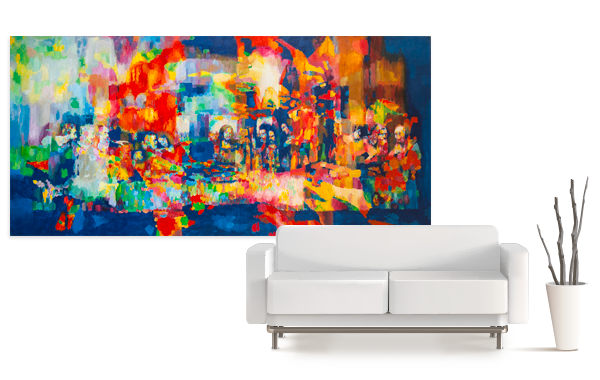
This topic came to Vladimir Zunuzin in his dream: the triptych which central canvas depicts a kind of view to the Earth from an outer space. But the image looks much more alike a tightly twisted spiral, than a Globe.
On the left to the central picture part of the triptych a figure of a nude woman is standing full face to auditorium, and on the right one — a nude man is turning his back to it. The triptych is called "Adam and Eve".
— Why are the figures in the picture located so, — I address my question to the author, while studying these monumental canvases.
— The woman is standing full face to us, because she is always open to the world, she grants a life. And the man is in his eternal departure — to his hunt, war, work. He is strict and reserved.
It is a hard deal to describe the picture by words, but I greatly wish you imagined yourself the works by this wide-known artist, as they are full of interest by both their content and performance. They are really philosophic, though their author does not regard himself as a philosopher.
One feels a special kind of energy in his studio which all round is hang and crammed with ready canvas. As if being painted by a magic brush, their heroes look animated and existing on their own, just from time to time returning to canvases, where the master has located them.
Look here — all black-dressed, alone and thoughtful, a famous Russian writer Dostoevsky is standing; his figure is almost completely back-grounded with a cloudy, anxious, violet sky.
Another picture — laying naked Michelangelo is painting his illustrious frescoes. This work is full of black, gray, dark-green colors. And only the palm-palette and the brush's tip are red-colored: all the great masterpieces are blood-created.
At the "Solitude" canvas the studio's host is shown crucified like the Christ.
— Every person is a lone one, — Vladimir Zunuzin is reasoning. — It enters this world singly, dies singly, and, in the final analysis, lives by itself — as within the shell of its own. And this is good, that a person is a closed one. Only in such a case it can store anything in its soul, and will have what to give other people. Should the shell be ruined — and there will be no personality any more. Just like a cell or a unicellular organism. Microcosm — macrocosm. "Electron is as well inexhaustible as atom is".
One more feeling appears while watching this canvas: the crucified artist serves as a connective line between the Heaven and the Earth. He is a transformer of divine, via his creations endeavoring to dispatch, to implement some message from Above. Who knows?…
— The secret of any pictorial canvas is in impossibility of its verbal description. One ought to sense, to feel it. Volume of colors, tones, shapes — these are "the words" of painting. And all these are to be perceived in their unity only. The same way as in music: we do not analyse a musical composition into the separate notes, we just listen, feel and admire it. Painting is the music visible to us, and music is the audible painting, — the artist is sharing his idea with me.
— You have devoted a lot of powers, senses and emotions to your canvases. Which of them was the most difficult for you, and which one is "the dearest child"?
"Russian Bath" was the most complicated at work. Where only a woman's figure hadn't stand! I wished to express all the mysteriousness and significance of a bathhouse in life of the Russian people: as it was the very place, where they were not only washing, but also giving birth to babies, taking medical treatment and making fortune-telling. A bathhouse was the major site for actions connected with both a human body and soul. I should say that the foreign spectators are usually even more impressed by this picture than ours.
— Perhaps, it seems to them exotic, and for the Russians it is just a habit and a custom. Till now many of our compatriots enjoy washing at country-side bathhouses.
We go on with watching the canvases. They are everywhere in the studio. Finished works are either hanging or standing near its walls.
One can see the works by Vladimir Zunuzin at vernissages and exhibitions in Arts salons and the Ulyanovsk Memorial Centre's (the centre of local history, culture and music) exhibition hall, in the Wedding Palace and offices of Banks and large companies. The artist is a really successful man, satisfied with his life and fortune.
— Vladimir, your life is going in a lucky way. And due whose merit is it?
— This is a destiny. I was just trying to make everything that my destiny was sending to me well and with a high quality.
— And if you were failing?
— I was continuing my work all the time, was going on and on. Only the person, who is full of patience and able to wait, can become a winner. A one, who avoids his circumstances, will always stay a looser; but a man, who follows his way and completes everything till the final goal — shall win. And, in such a case, any wish, even the most unbelievable one, may be achieved.
— Tell please, what is the secret of your luck.
I think, that a man, simply possessing with something, but not applying it, scarcely will achieve even a small result. He either will be going against himself and against the plans destined to him, or will not achieve a marked goal due to a lack of patience. And than, they — "From the Above" — will look at him and think: "As he was short of patience, so, let us bereave him of what he has". One more point is of the great significance — "to take your own train truly". Everyone has a ticket and a train of his own, destined to him only. And he needs to find it exactly, but not to take the place of someone else, as, at any case, nothing good will follow it. The ability to lend an attentive ear to one's own inner world is very important too.
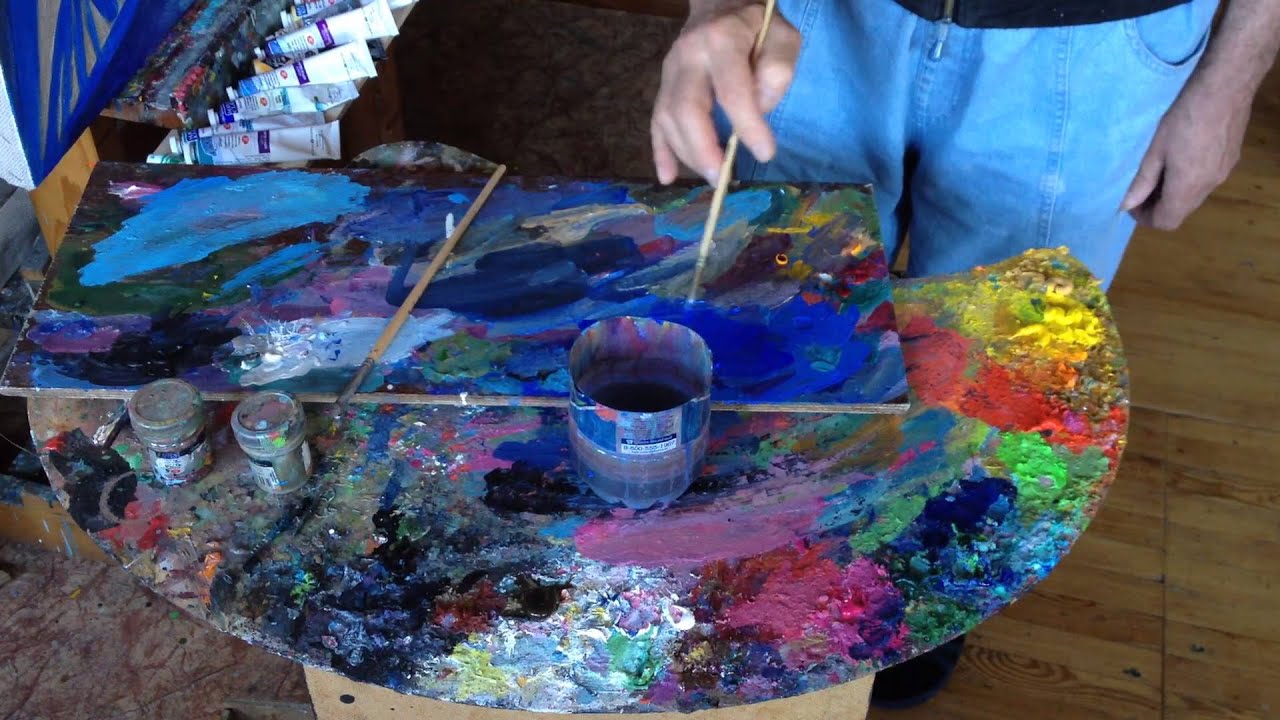
Today the artist is also in the permanent creative search: he tries himself in an abstractionist art painting. Here he makes computerized sketches first, and then transfers them to a canvas. He regards a computer as the tool which grants him a new way for reality's portraying. The fortunate destiny of Vladimir Zunuzin serves a one more eloquent testimony of an old truth: "Labor, involved in talent, conducts to the success".